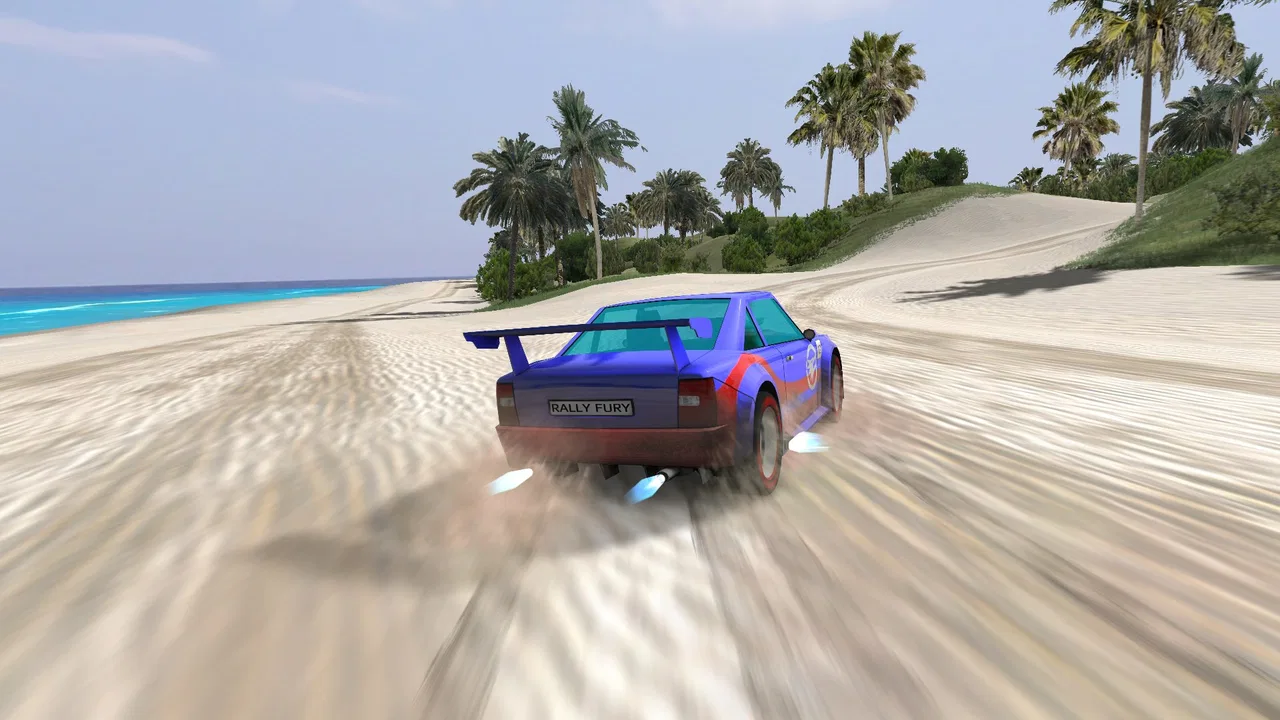
Rally Fury - Extreme Racing
- 3.9
- Rating
- 100.00M
- Installs
- Free
- Price

 Analysis by App-foxy
I spent time with Rally Fury - Extreme Racing as a quick, touch-friendly rally game, and its defining strength became clear almost immediately: the driving is built around controlled drifting rather than simply steering from one checkpoint to the next. That choice gives every corner a small decision attached to it. I am not only asking which way to turn; I am deciding when to loosen the car, when to hold the slide, and when to use the boost without throwing away the exit.
That focus makes this a more involved experience than its simple presentation first suggests. It is a free racing game from Refuel Games Pty Ltd, available for Android and iOS, with an Everyone age rating. The game has been around since October 11, 2017, and its current version is 1.120. With over 100 million installs and an average rating of 3.8 from around 952 thousand ratings, it clearly appeals to a very broad mobile audience.
I would not describe it as a full simulation. It sits closer to an accessible arcade rally racer, but the drifting gives it enough timing and rhythm to reward practice. If you want a serious motorsport management game, a huge open-world racer, or a deeply technical simulator, this is not the right destination. If you want short races where improving your cornering immediately makes you feel faster, it is much easier to recommend.
You May Also Like

 Blood Strike: 2.5 Anniversary
Blood Strike’s Loadouts Turn Every Drop Into a Tactical Gamble
A close look at Blood Strike’s custom loadouts: how fast access to signature weapons reshapes its battle royale rhythm, rewards preparation, and narrows the gap between fights.

 Pandora - Music & Podcasts
Pandora’s Music Is Easy to Start, but Harder to Recover
Pandora’s strength is its low-effort path from a seed to a station. Its weak spot is how much confidence it asks you to place in connection, setup, and quiet recovery.

 8 Ball Pool
 Is Built on Rivalries, Rematches, and Routine
A close look at the rivalries, rematches, shared routines, and unanswered safety questions that turn a quick pool match into a persistent mobile community.

 Samsung Music
’s Quiet Strength Is Playing What You Already Own
Its reach comes less from spectacle than from dependable access to a personal library. That simplicity is both the app’s strongest retention engine and its ceiling.

 AccuWeather: Weather Radar
AccuWeather Review: A Quick, Clear Forecast for Everyday Decisions
For everyday plans, the best forecast is the one you can understand quickly. AccuWeather makes rain timing, radar, and local conditions easy to act on, with a few trade-offs.

 Hill Climb Racing
Why Hill Climb Racing Still Turns Crashes Into One More Run
A tiny car, a bumpy hill and one more upgrade: Hill Climb Racing keeps resurfacing because its simple chaos makes every near-miss feel personal.
More From Our News Desk



Why drifting is the game’s real identity
The most important capability here is the ability to slide through corners while keeping enough control to preserve speed. In a typical casual racer, steering can feel like a simple left-or-right instruction. Here, the car’s angle matters. A corner becomes a sequence: position the car, begin the turn, let the rear move, correct the slide, and prepare for the straight that follows.
That makes the boost more interesting too. A boost is most useful when the car is already pointed in a productive direction. Activating it halfway through a messy slide may create speed, but not necessarily progress. I found myself treating boost as a reward for a clean exit rather than as an emergency button. That small change in thinking is one of the game’s best lessons.
The result is a driving loop that feels good in short sessions. I can play one race while waiting for something, then restart because I know exactly where I lost momentum. The game encourages that “one more attempt” feeling without requiring a long commitment. A strong run is not just about finishing first; it is about making the difficult corners look deliberate.
There is also a useful difference between a controlled slide and a panic correction. New players may initially turn too sharply, overcorrect, and lose the line completely. I had better results using smaller steering movements and beginning the turn earlier than instinct suggested. The visual drama of a long drift is tempting, but a shorter slide that keeps the car aligned is often faster.
How the controls feel during an actual race
The controls are designed for touch screens, so the game is approachable even if you are not used to mobile racing. I could concentrate on the road rather than learning a complicated control system. That matters on a phone, where a race may be interrupted by a notification, a cramped grip, or the simple fact that I am playing with one hand available.
The trade-off is that touch controls do not provide the same fine feedback as a physical controller. When the car begins to rotate, I have to judge the movement visually and react quickly. Players who enjoy precise analog steering may find the input less satisfying than a console racer. For everyone else, the simplicity is a benefit, especially during the first few sessions.
I recommend adjusting your hand position before starting a serious attempt. On a larger phone, my thumbs could cover more of the screen than expected, particularly during a sharp turn. Holding the device slightly farther from my face and using lighter taps made it easier to see the car’s line. This sounds minor, but rally racing punishes blocked visibility more than ordinary traffic-free arcade driving.
Another practical tip is to avoid chasing the biggest-looking drift. A dramatic sideways angle can feel successful while quietly bleeding speed. I improved more by watching where the car pointed at the end of the corner than by judging the length of the slide. If the nose is aimed at the next section of road, the drift has done its job.
What the boost changes in practice
Boost adds a second layer of timing to the drifting focus. Used on a straight, it can turn a clean corner into a useful speed gain. Used while the car is still fighting for direction, it can make the next correction more difficult. I began saving it for moments when the car was stable, especially after a corner or jump where the landing had left me properly aligned.
This also changes how I approach jumps. Catching air is visually exciting, but the landing is where the race is often decided. A boost activated before a jump may give a satisfying launch, yet the extra speed can make the landing harder to manage. I preferred entering jumps with a straight car and using the boost only when I had a clear recovery path.
That is a useful distinction for beginners: speed is not automatically progress. The fastest-looking action may create a poor angle for the next turn. Rally Fury works best when I think in connected sections instead of isolated stunts. A corner, jump, and straight should be treated as one driving problem.
The game’s appeal comes from this relationship between spectacle and restraint. It gives me drifting, jumps, and boost, but winning still depends on not wasting them. That balance is why the central capability feels more meaningful than a decorative effect.
How it works when I play for a few minutes
My usual session starts with a quick race rather than a long setup process. That makes the game suitable for short breaks, but it also means the experience is built around immediate action. I do not need to prepare a detailed strategy before driving. I simply choose a run, learn the shape of the route through repetition, and gradually reduce the mistakes that cost time.
The first attempt on an unfamiliar course is mostly reconnaissance. I look for corners that tighten, areas where a jump changes the car’s direction, and exits where boost might be safe. On the second attempt, I can focus less on surviving and more on linking the sections together. This is where the drifting system becomes satisfying: the route stops feeling like a sequence of surprises and starts feeling like a rhythm I can practice.
I found that restarting is worthwhile when I make an early mistake. Because the game is free and designed for accessible sessions, there is little reason to drag a poor run to the finish if my goal is improvement. A restart lets me test one adjustment immediately, such as braking my turn slightly earlier or using a smaller correction after the slide begins.
That workflow is particularly helpful for players who do not usually play racing games. Instead of needing to understand advanced vehicle setup, I can improve through visible driving decisions. The learning curve is still present, but it is expressed through timing and positioning rather than a wall of technical menus.
A realistic everyday use case
Imagine having ten minutes before a train arrives. I would open the game, play one race to warm up, and use the next attempt to work on a single problem corner. I would not try to master the entire course at once. I would watch whether the car entered too wide, whether the drift began too late, and whether the boost was being wasted before the exit. That turns a short wait into a focused practice session rather than a random burst of play.
The same approach works after a frustrating day when I want something active but not demanding in the way a large competitive game can be. The controls are quick to understand, and the races provide immediate feedback. At the same time, the drifting gives me enough to concentrate on that I am not merely watching the car move.
It is less suitable for a quiet, low-attention moment. If I am distracted, the game’s quick corrections become difficult, and a missed turn can ruin the run. This is not a background game that I can play while doing something else. Its short sessions are convenient, but the driving still asks for attention.
Where it differs from familiar racing alternatives
Compared with a straightforward traffic racer, Rally Fury feels more deliberate because the road itself is the challenge. There is less emphasis on weaving through ordinary vehicles and more on managing a rally-style route. That makes it a better choice for someone who enjoys corners, jumps, and repeated attempts at the same section.
Compared with a realistic simulator, it is much easier to pick up. I do not need to know racing terminology or spend time learning a complicated setup before I can have fun. The price of that accessibility is depth: players looking for detailed vehicle physics, extensive tuning, or a serious competitive structure may eventually want a more specialized game.
Compared with a large open-world racer, this is more focused and less immersive. I am here to drive the course, not to explore a large map or build a long-term driving lifestyle. That narrow purpose is a strength when I want a quick race, but a weakness if discovery and variety outside the track are my main reasons for playing.
The game’s broad reach is understandable. It is free to download, carries an Everyone rating, and has attracted more than 100 million installs. However, its 3.8 average from around 952 thousand ratings also suggests that the experience will not satisfy everyone equally. I think the split comes from expectations: arcade rally fans will understand what it is trying to do, while simulation fans may find it too light.
Where the experience asks for patience
The biggest limitation is the gap between easy controls and difficult consistency. I can understand the basic idea quickly, but repeating a clean drift through several corners takes practice. A player may feel comfortable after a few races and still struggle to produce a genuinely smooth run. That is not a flaw by itself, but it can be frustrating if you expect immediate mastery.
Touch input is another compromise. It works well enough for the game’s arcade style, yet it does not always communicate subtle changes in grip or angle. I sometimes corrected too late because the car’s movement was easier to see than to feel. Players using a controller, when supported by their device setup, may prefer a different mobile racer with more explicit precision, but the game remains playable through its intended touch approach.
The free-to-play structure also deserves attention. In-app purchases range from $1.49 to $49.99 per item. That does not automatically make the game unsuitable, but it means families should be aware that optional spending is part of the experience. Since the game is rated Everyone, I would still enable the purchase protections on the device before handing it to a child.
I also think the game can feel repetitive for players who need constant novelty. Its pleasure comes from refining driving, not from changing genres every few minutes. If repeating a route to improve a corner sounds boring, the central design may not hold your attention. If you enjoy shaving mistakes from a familiar sequence, repetition becomes the point.
Another trade-off involves visual excitement versus practical control. Drifts and jumps create memorable moments, but the most effective run is often less spectacular than the most entertaining one. I had to learn not to confuse a long slide with a good slide. The game rewards the driver who keeps momentum, even when that means choosing a modest correction instead of a showy maneuver.
Three habits that noticeably improve runs
Use the first run to map decisions, not chase victory. I look for the corners where a late turn creates a bad exit and note which jumps require a straight approach. This reduces random restarting and gives each attempt a purpose.
Separate drift control from boost timing. I let the car settle before using boost whenever possible. Combining both actions in a messy corner often produces speed without direction, which is less useful than a slower but stable exit.
Judge the landing before celebrating the jump. I keep the car aligned through the approach and make my next decision only after seeing where it settles. This is especially useful when a jump leads directly into a turn.
These habits are not complicated, but they change the game from button pressing into deliberate driving. They also help answer a common question new players have: should they prioritize drifting or boosting? My answer is drifting first. A reliable line creates more opportunities for boost; boost cannot repair every poor line.
Who gets the most from this rally racer
I would recommend it to someone who wants an arcade racing game that can be understood in minutes but practiced for much longer. It is especially well suited to players who enjoy improving through repetition, prefer short mobile sessions, and like the feeling of carrying speed through a corner. The free entry point makes it easy to test that style without committing to a purchase.
It also works well for casual players who want more involvement than an automatic runner provides. You have to steer, manage the slide, and choose when to use the boost. Those decisions are simple enough for a newcomer, but they still create a noticeable difference between a messy run and a clean one.
I would be more cautious recommending it to a player who wants realistic car behavior or extensive customization. The game’s appeal is immediate arcade control, not technical authenticity. A simulator-style alternative would be better for someone who wants to study braking points, vehicle setup, and detailed handling differences.
It is also not my first choice for someone seeking a social racing experience as the main attraction. The strongest reason to return is personal improvement behind the wheel. If your ideal racing game is built around a large community, deep competition, or an expansive world, another category of racer may fit better.
Parents should note the combination of an Everyone rating and optional purchases. The age rating makes the game approachable for a wide audience, while the purchase range means device-level controls are still sensible. For an adult player, the free model is a convenient way to see whether the driving loop clicks before spending anything.
My recommendation after living with the driving loop
After playing it as a quick arcade racer, I see the drifting system as both its strongest feature and its clearest filter. It gives the game character, makes corners worth practicing, and turns boost into a timing decision rather than a simple speed button. It also means the experience depends heavily on whether you enjoy repeating a section until your hands learn the right correction.
The developer, Refuel Games Pty Ltd, has kept the basic idea accessible enough for mobile play, and the game’s long presence on Android and iOS is reflected in its broad audience. The current version, 1.120, is the one I would look for when installing it, while remembering that the free download includes optional purchases.
My honest verdict is that Rally Fury is best when you want focused arcade rally driving, not a complete racing simulation. I would install it for short sessions, practice the corners that keep ruining my runs, and use boost only after the car is under control. If that sounds satisfying, this is an easy game to try. If you would rather explore, tune, or compete in a highly realistic environment, it is better to choose a different racing experience.
For me, the deciding question is simple: do you enjoy making a corner cleaner on the next attempt? If the answer is yes, the game has enough control and momentum to keep pulling you back. If the answer is no, the jumps and boost will not hide the repetition for long. That makes it a focused recommendation, but a genuine one.
FAQs for Rally Fury - Extreme Racing
01What is Rally Fury - Extreme Racing?
Rally Fury - Extreme Racing is an exhilarating racing game available on both Android and iOS platforms. It offers players a chance to experience the thrill of high-speed rally racing with realistic physics, challenging tracks, and customizable vehicles. The game is designed for both casual players and hardcore racing enthusiasts, providing hours of entertainment.
02Are there in-app purchases in Rally Fury?
Yes, Rally Fury includes in-app purchases. While the game is free to download, players have the option to buy in-game currency, which can be used to unlock new cars, tracks, and customization options. These purchases can enhance the gaming experience but are not necessary to enjoy the core features of the game.
03Does Rally Fury support multiplayer gameplay?
Rally Fury offers a multiplayer mode where players can compete against friends or other racers online. This feature adds a competitive edge to the game, allowing players to test their skills against real opponents, climb leaderboards, and showcase their racing prowess in a global community.
04What are the system requirements for Rally Fury?
For Android users, Rally Fury requires a device running Android 4.1 or higher, while iOS users need a device running iOS 9.0 or later. It is recommended to have a device with decent processing power and sufficient storage space to ensure smooth gameplay and optimal performance.
05Can you customize vehicles in Rally Fury?
Yes, Rally Fury allows players to customize their vehicles. You can upgrade your car’s performance parts, change its appearance with new paint jobs, and add decals. This customization feature lets players personalize their racing experience and optimize their vehicles to suit their racing style.
Pros
- Stunning graphics enhance the racing experience.
- Responsive controls for precise maneuvering.
- Wide variety of tracks keeps gameplay engaging.
- Multiplayer mode adds competitive excitement.
- Customizable cars offer personalized play.
Cons
- In-app purchases can be costly.
- Ads may interrupt gameplay frequently.
- Limited car selection without purchases.
- Requires constant internet connection.
- Occasional lag in multiplayer mode.

Rally Fury - Extreme Racing
Gallery